
The naive statement “Google knows everything, why learn anything?” has now been transferred to AI, and needs to be tackled head on. Nevertheless, the fair question AI raises, “What should students learn for the age of AI?”, needs to be addressed. AI is thus forcing a deep re-examination of the role of Disciplinary Knowledge in Education.
Expertise AND Transfer
Expertise is needed for employability, and Transfer for wide and wise, societal and personal, application of Knowledge in various real-world settings.
A) Acquisition of Expertise: The Knowledge aspect of a discipline needs to be enhanced: as AI easily replicates the Declarative and Procedural aspects of the discipline, students will *also* need to learn the Conceptual and Epistemic layers, to interface with AI at a more robust level, capable of challenging the AI’s responses. Deep expertise is the combination of all four levels. An example of a Concept in Mathematics is “deceiving then explosive’ for an exponential, whilst the content is its algebraic formulation f(x) = ex. Similarly, learning Epistemics will require understanding what constitutes the discipline (via four seminal questions). This implies revisiting what is considered “foundational” declarative and procedural knowledge (aka “Essential Content”), which is difficult to do, and where personal biases abound.
Modernizing Traditional Disciplines: Alignment with a modern world requires modernizing traditional disciplines2: After all, for instance, why so much trigonometry, and so little data science, in a modern world? All disciplines require the removal of obsolete items carefully (“with a scalpel, not a chainsaw”).
Furthermore, “dosing” complexity wisely will be essential in reshaping declarative and procedural standards: each standard should be tagged as one of three tiers of complexity (Produce, Interpret, Appreciate).
Adding Modern Disciplines: For a modern world, the following disciplines need to be made mandatory in K-12, as they a essential to employability, personal, and societal growth, yet they are crowded out by traditional disciplines and are spottily available as options at best::
- Technology and Engineering: Economic drivers are mostly related to “anything-tech”: Biotech, Nanotech, Cleantech, AI/CS, advanced manufacturing, FinTech, FashionTech (wearables), HealthTech, etc.
- Social Sciences: understanding oneself and others is a critical need in a fragmenting world.
- Entrepreneurship: is, in itself, the job of the future, as disruptions to traditional staid careers abound, due to AI and other factors.
Interdisciplinarity and cross-disciplinarity: The former can be described as a number of Themes that can be incorporated as exemplars of various content items, and depending on the conduciveness of a given Discipline; while the latter will be developed via Projects (which should be mandatory for each course)
B) Exercising Transfer: Knowledge remains inert unless it is:
- Demonstrated in multiple settings, for near to far transfer; this can be achieved via real-world multidisciplinary projects and internships.
- Used properly (“Skills”), with the appropriate behavior and engagement in the world (“Character”), with the necessary reflection, adaptation, learning how to learn (“Meta-Learning”) and to do so continuously given AI. Such competencies are required in more than 40 US States. Disciplines are more or less conducive to developing a specific competency (e.g. Communication and Language). Furthermore, AI requires discrimination about which facets of competencies will matter more, as less replaceable by AI (for instance, Imagination, in Creativity).
The complete framework’s diagram can be found below.
The recommendations summarized herein have been researched and described in great detail in CCR’s books “Four-Dimensional Education” and “Education for the Age of AI”.
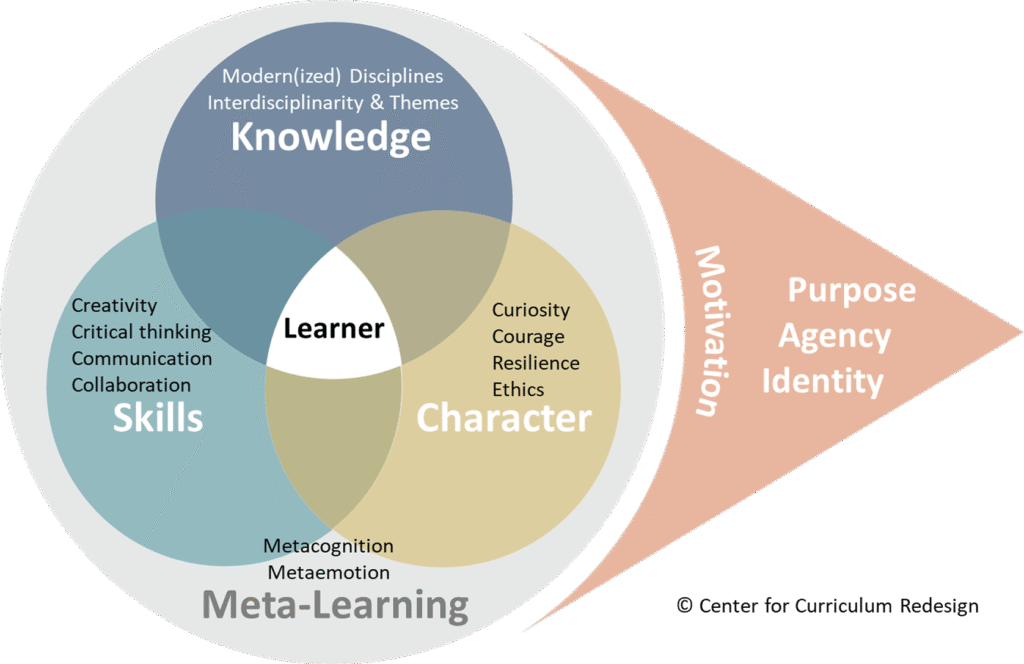
Four-Dimensional Education (Source: CCR)
1Scaffolding still matters greatly, hence the need to learn declarative and procedural layers, but more discriminantly, as described herein.
21. What counts as evidence? 2. How is that evidence generated? 3. How are claims justified or refuted? 4. How is knowledge communicated and updated?
3CCR has developed criteria to do so, which are beyond the scope of this paper
4https://curriculumredesign.org/modern-mathematics/
5Environmental Literacy; Global Literacy; Information Literacy; Systems Thinking; Design Thinking; Digital Literacy; Computational Thinking.
6https://curriculumredesign.org/wp-content/uploads/Interdisciplinary-Themes.pdf
7Creativity, Critical Thinking, Communication, Collaboration
8Curiosity, Courage, Resilience, Ethics
9Metacognition, Metaemotion
10“Education for the Age of AI”, Chapter 6, Pages 148-151