
The Call: Why Learning Must Change
“The water is contaminated.”
“My classmate was murdered.”
“My mother lost her job to AI.”
These aren’t headlines. They’re words spoken by scholars in Mississippi – teenagers carrying responsibilities most adults would find hard to bear.
When they ask, “Why should I care about school?” they’re not resisting learning; they’re signaling that learning must rise to meet their lives.
This is the tension of our time: the system designed to prepare young people for the future is moving slower than the future itself. Automation, climate instability, and inequality demand humans who can think critically, act ethically, and adapt continuously. Yet too often, instruction (and school more generally) still trains scholars to recall, repeat, and comply.
RevX believes learning should evolve as the world does. It must help young people become the kinds of humans AI struggles to replace – curious, ethical, and capable of shaping change.
Learning as a Human Act
The skills most essential in the age of AI – communication, creativity, resilience, ethical reasoning, adaptability – aren’t new. They’re expressions of what makes us human. Behind each are two capacities that shape all the rest: agency, the power to act, and transferability, the ability to apply learning in new contexts in order to achieve the goals we want.
Traditional education rarely cultivates either. It fragments knowledge into subjects that live apart from life.
That’s why RevX created DEEDS. If AI can do the recalling, humans must do the discovering. DEEDS helps scholars develop what machines cannot: the ability to discover problems that matter, examine them with curiosity and empathy, design solutions grounded in community need, and share learning in ways that inspire collective action.
Through DEEDS, young people learn to see themselves as capable of shaping and leading their communities. They build habits of inquiry, collaboration, and reflection that help them continue learning – no matter how the future shifts.
When learning becomes a living process, it stops being about right answers. It becomes a practice of asking better questions and using learning to make life better for us all.
DEEDS: The Architecture for Real World Learning
DEEDS – Discover, Examine, Engineer, Do, Share – is not a curriculum to follow. It’s a cadence of learning that helps teachers and scholars move from curiosity to impact while keeping rigor and relevance at the center.
Discover begins with a real challenge that matters to the community.
Examine grounds curiosity in evidence, data, and multiple perspectives.
Engineer invites scholars to design solutions that demand both academic precision and creativity.
Do brings those ideas to life in partnership with others.
Share closes the loop as scholars communicate what they’ve learned, how their view of who they are has sharpened (identity), and how they have created change. They demonstrate this evolution through exhibitions, advocacy, or community action.
The topic can shift – from AI bias to coastal flooding to mental health – but the process remains steady. It gives teachers structure without scripting and gives scholars freedom without losing the rigor of the learning process.
DEEDS helps teachers, too. It turns planning into design thinking and lesson delivery into shared inquiry. It reminds educators that their role isn’t to provide all the answers but to guide the search for collective meaning. Our AI tool, Design with DEEDS amplifies teachers’ capacity to plan.
What It Looks Like In Action
The earlier sections describe why and how learning must change, these stories show how young people are already living that future.
First Grade | Helping Foster Youth Sleep
In the Bronx, first graders learned that foster youth often struggle to sleep in new homes. They studied the science of light and sound, engineered night-lights and rainsticks, and delivered comfort kits to a local foster organization to help improve foster youth’s sleep.
Fourth Grade | Making Intersections Safer
When fourth graders noticed that cars rarely stopped at their crosswalk, they partnered with Transportation Alternatives to gather data, study the physics of force and motion, and design safer intersection models. Their petition drew hundreds of signatures and the attention of city officials.
Eleventh Grade | Promoting Mental Health
In Mississippi, high school scholars confronted rising anxiety among their peers. After analyzing local data and partnering with NAMI Mississippi, they designed awareness campaigns for athletes and artists, hosted a districtwide event, and presented recommendations to the school board. Their proposals led to new wellness programs funded at the district level.
In every example, scholars build the foundational knowledge they need while also developing empathy, agency, and a commitment to contributing to their communities. Both the purpose and process of learning shift: scholars learn in order to create real impact, and the work itself requires continuous investigation, application, reflection, and iteration.
Proof of What is Possible in Learning Environments
At LEAD Public School 359 in the South Bronx, RevX’s first demonstration site, scholars and teachers are showing what’s possible when relevance and rigor meet.
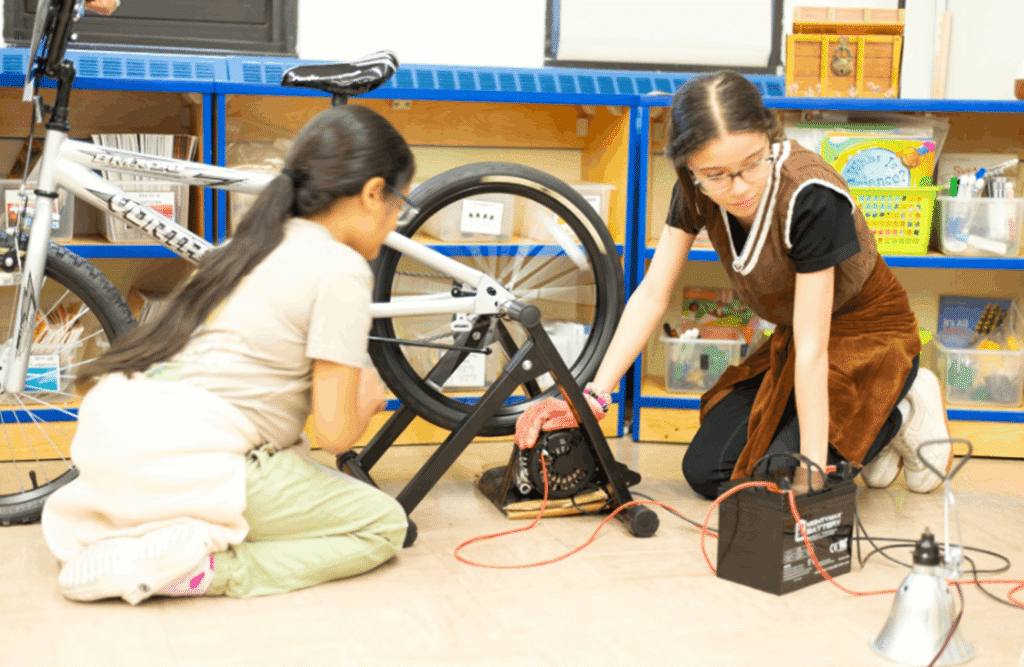
LEAD 359: In this project for the NYC Department of Sustainability, fourth graders built a pedal-powered energy system that transforms movement into clean electricity—tackling two problems at once: the need for healthier daily activity and the urgency of reducing fossil fuel use in schools. Their solution required real academic muscle—literacy to study similar systems, math to measure power, science to understand energy transfer, and collaboration to test and refine every design. It’s a clear example of how DEEDS turns real challenges into rigorous, human-centered learning.
Over four years, LEAD has seen consistent increase in scores. Most recently in 2025:
- 99% proficiency in English Language Arts
- 95% proficiency in math
- 90% proficiency in science
- 100% teacher retention
The numbers tell part of the story. The rest lives in the moments that can’t be measured – the hum of a group building prototypes after dismissal, a student revising her argument because the data changed her mind, a teacher realizing that inquiry, not compliance, keeps scholars engaged.
Teachers describe DEEDS as the approach that reminded them why they became educators. Scholars choose to stay after school, not for extra credit, but to keep working on ideas they started.
This is the proof the future demands: not just higher scores but deeper reasons to learn, to collaborate, and to contribute. What these stories prove is simple: when learning is human-centered and real, scholars excel academically and develop the agency, adaptability, and purpose the future requires.
Learning That Embraces Change
The kind of work our scholars do requires what the future requires – clear communication, real collaboration, and sustained self-direction. It moves learning away from narrow tasks and toward rigorous relevance; away from isolation and toward connection; away from one-size-fits-all and toward customization; away from passive compliance and toward agency. It is the shift at the heart of Transcend’s LEAPS for Extraordinary Learning.
The strength of DEEDS is that it adapts as the world does. Topics change, tools evolve, and conditions shift, but the pedagogy bends with that movement. It acts as a flexible container – structured enough to support rigorous thinking, open enough to hold work that reflects students’ interests, identities, and the challenges their communities face.
As scholars move through this process again and again, it becomes a way of seeing the world. Every question becomes a chance to understand, design, and contribute. Teachers begin to see every lesson as part of a larger arc of human growth and community change.
This is the future of learning – not flashy, not theoretical, but deeply human.
A system that holds its soul because relationships, identity, and purpose remain at the center.
A design that maintains its rigor because evidence, precision, and iteration guide each step.
A model that prepares young people not just to navigate change but to shape it.
DEEDS threads all of this together: strong academic outcomes, meaningful contribution, and the human capacities AI cannot replace – agency, relevance, connection, creativity, and ethical reasoning. It shows that when learning is built for both rigor and humanity, scholars rise.