
Educators are not only found in classrooms. They are anyone – youth or adult – who engages young people in powerful learning experiences that spark curiosity, deepen knowledge, build skills, and help young people make meaning of who they are and how they can contribute.
We’ve long known that learning happens everywhere. What’s different now – in the Age of AI – is the urgency to act on this knowledge.
As new technologies continue to transform work, the pathways from school to career are becoming more fragmented, unpredictable, and uncharted. Entry-level jobs are disappearing or changing faster than systems can adapt. In this landscape, young people need to learn not only how to acquire content, but how to navigate complexity. They ne ed trusted adults and near-peers who can help them develop the durable skills, sense of direction, and social capital needed to explore existing pathways and forge new ones.
Especially for adolescents – youth and young adults ranging from ages 12 to 25 – this makes the definition of educator much broader to include:
- Classroom teachers who connect foundational academic content to real-world applications and help young people explore the advanced courses, electives and extracurricular activities that fuel their spark.
- Community-based educators, youth work professionals, and program staff who design learning that’s reality-based, relationship-rich, and purpose-driven – especially for those who feel disengaged from traditional schooling.
- Professional Support staff – including nurses, counselors, coaches, librarians, safety officers and other support staff who are essential for making schools and community organizations vibrant and supportive places for learning and engagement.
- Employers, trainers, and mentors who help young people build competencies in their places of work – especially in internships, apprenticeships, or paid programs.
- Service corps leaders and team supervisors who challenge youth to contribute meaningfully to their communities, developing leadership and character along with transferable skills and knowledge.
- Peers and near-peers who develop projects and reinforce learning through shared experience, cultural connection, and social capital.
“The activities that I engage in outside of school are profoundly instrumental to my educational experience… Work with outside organizations feels more purposeful and intentional compared to school.”
-High school student in New York, from a Transcend survey
While many of these educators may not hold a teaching degree, they absolutely facilitate learning. And their role is essential to how youth and young adults explore interests, take risks, make meaning, and enter into adulthood.
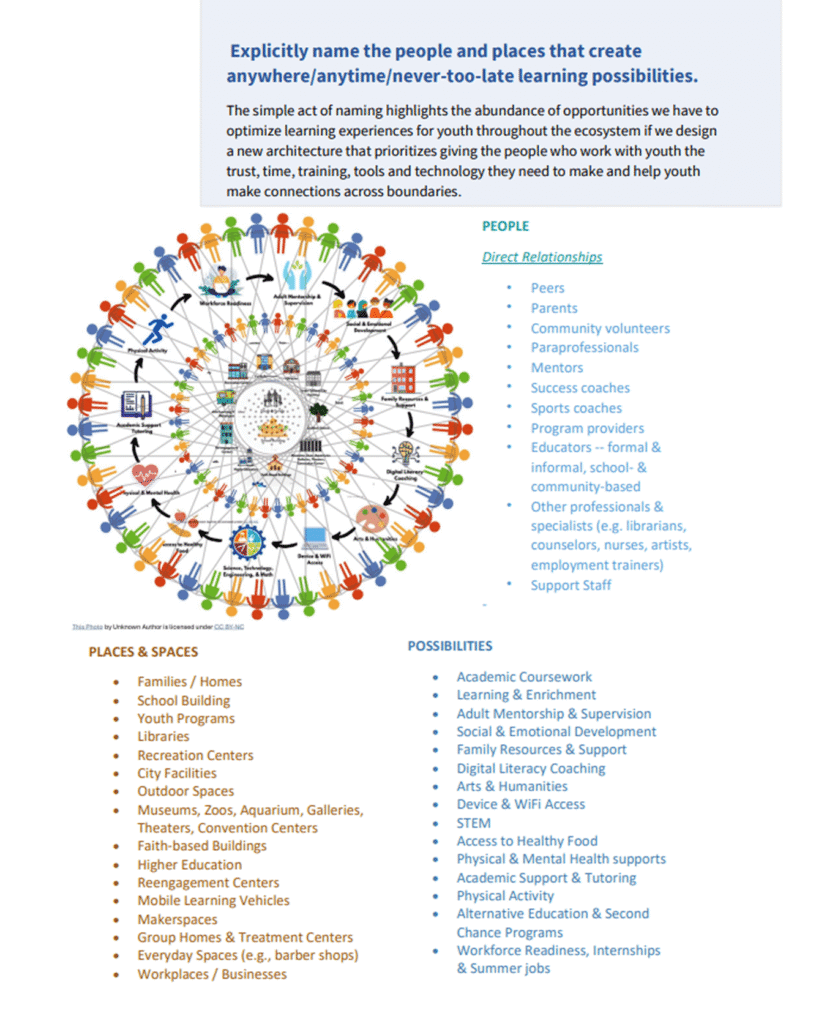
As we note in When Youth Thrive, We All Thrive , we must:
Explicitly name the people and places that create anywhere/anytime/never-too-late learning possibilities. The simple act of naming highlights the abundance of opportunities we have to optimize learning experiences for youth throughout the ecosystem if we design a new architecture that prioritizes giving the people who work with youth the trust, time, training, tools and technology they need to make and help youth make connections across boundaries.
So what do we do? We make a new commitment – to recognize and support a broader community of educators.
This means:
- Naming and legitimizing the full range of youth-facing adults as educators – across schools, community programs, service corps, libraries, arts and cultural organizations, job sites, and beyond. This includes adopting inclusive language and messaging in policy, research, and public communications.
- Expanding educator preparation and professional learning – ensuring that youth workers, mentors, community educators, and others have access to high-quality training and development opportunities, just like classroom teachers. And creating shared spaces for learning together about the most powerful ways to engage young people in learning.
- Creating new roles and career pathways – especially for those who work at the intersection of learning, work, and community. We need credentialing systems and job categories that reflect the actual learning ecosystem – including roles like learning pathway navigators, success coaches, and ecosystem stewards.
- Building systems for shared measurement and learning experience design – so that educators across settings can design, evaluate, and continuously improve experiences that are rigorous, relevant, and youth-centered.
- Integrating real-world and out-of-school learning into formal education systems – including giving credit for community-based learning, aligning goals across settings, and ensuring these educators are part of student support and learning planning processes.
- Investing in relationship infrastructure – the staffing, scheduling, and collaboration time needed for educators across systems to build trust, coordinate efforts, and co-design learning pathways with youth and families.
“The primary focus should be on whether the adults employed by the separate systems that support youth thriving have the capacity and motivation to see themselves as interconnected actors and whether they are supported and valued for their diversity, not just in terms of race, gender, or generation, but also in terms of training, titles, and temperament.”
Too Essential to Fail: Why Our Big Bet on Public Education Needs a Bold National Response (Pittman & Irby)
Much of this work is underway but rarely connected. Afterschool systems have spent decades building professional development and continuous quality improvement systems that focus on creating relationship-rich learning environments and personal agency. Service corps, opportunity networks, and STEM networks train adults to work with young people in designing and implementing projects that tackle real-world challenges. We must scaffold these ongoing efforts into more intentional and vibrant ecosystems at the community level, where young people live, learn and explore. This is not simply about scaffolding together the existing systems at an institutional level but actually zooming in to strengthen the capacity and interconnections in the mesosystem – the people, places and possibilities that young people navigate everyday.
This is not a tweak – it’s a rethinking. The educator of the future isn’t defined by their title, but by their role in shaping powerful learning experiences that help youth thrive – across all of the places young people spend their time.
In the Age of AI, what young people need most is not just more content – it’s more connection, meaning-making, and human guidance.
And that makes educators – in all their forms – more important than ever.